

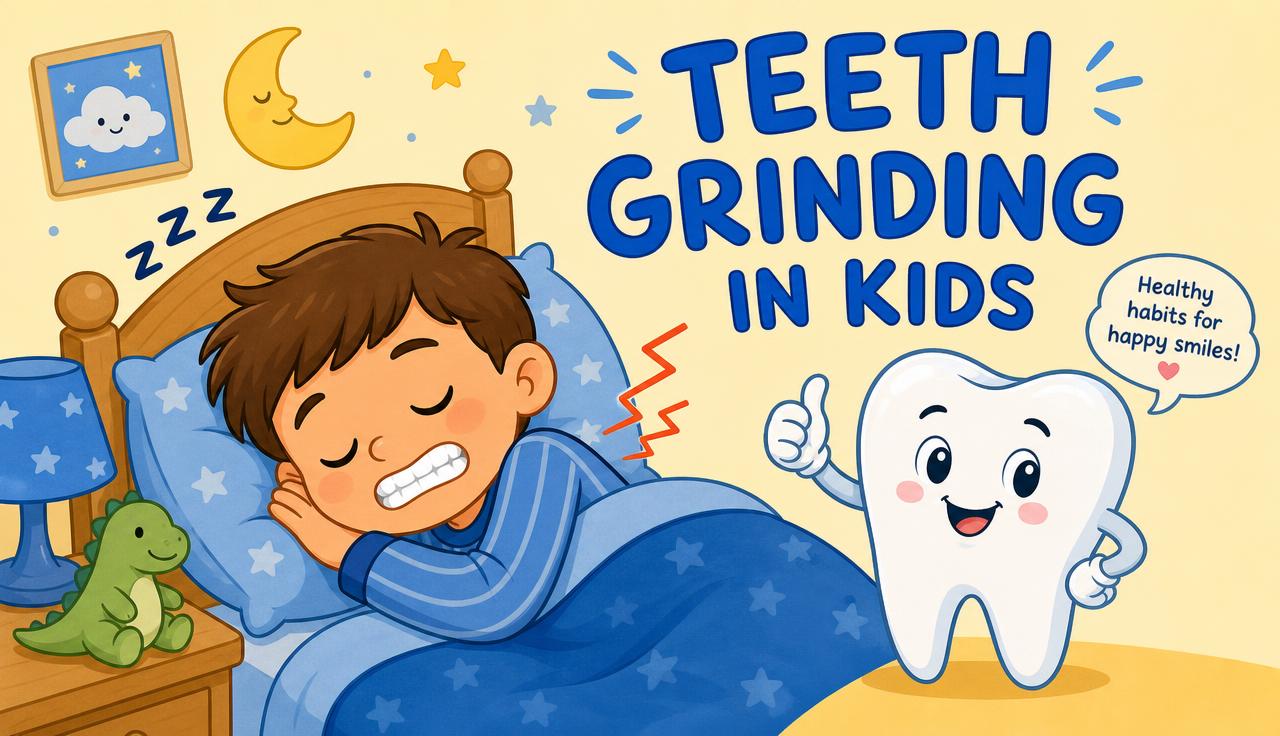
Quick answer: Teeth grinding (bruxism) affects up to 3 in 10 children and most grow out of it by age 10–13 without treatment. It becomes a problem when you see worn flat teeth, jaw pain, morning headaches or sensitivity — those children need a dental exam, and often the cause is a bite problem, blocked airway or sleep disturbance rather than "worms" or calcium deficiency.
Parents in Bharuch often describe the same night sound: a grating, creaking noise from their child's room. It is alarming to hear, but sleep bruxism in children is extremely common and usually self-limiting. Here is how to tell the harmless kind from the kind that needs a dentist.
What is bruxism in children?
Bruxism is involuntary clenching or grinding of the teeth, most often during sleep. In children it typically starts when the baby molars come in (around 2–3 years) and again when the permanent teeth erupt (around 6 years) — both times the bite is changing and the jaw is "searching" for a comfortable position.
Real causes of teeth grinding in kids
| Cause | What you may also notice | What helps |
|---|---|---|
| Erupting teeth / changing bite | Grinding phases at ages 2–3 and 6–7 | Usually resolves on its own; monitor |
| Misaligned bite (malocclusion) | Crowded, crooked or protruding teeth | Orthodontic assessment; may need braces |
| Blocked airway / mouth breathing | Snoring, open mouth in sleep, enlarged tonsils, restless sleep | ENT review — treating the airway often stops grinding |
| Stress and anxiety | New school, exams, family change, screen-time before bed | Calming bedtime routine, reassurance |
| Sleep disturbance | Late nights, irregular schedule, poor sleep quality | Fixed sleep timing, no screens 1 hour before bed |
| Pain elsewhere | Ear infection, teething discomfort | Treat the underlying cause |
Note what is not on that list: intestinal worms and calcium deficiency. Both are widely blamed in India and neither has good evidence as a direct cause of bruxism.
Warning signs your child's grinding needs treatment
- Flat, worn or chipped teeth — especially shiny flattened tips on the canines
- Sensitivity to cold water or ice cream
- Morning headaches or complaints of jaw or ear ache on waking
- Clicking jaw or difficulty opening the mouth wide
- Cheek biting or ridged indentations on the tongue edges
- Loud snoring or gasping during sleep — this needs urgent attention
How we treat bruxism at Little Angels, Bharuch
- Wear assessment — we measure how much enamel has already been lost and photograph it so we can track progress.
- Bite and airway check — we examine the bite, tonsils and breathing pattern, and refer to an ENT if the airway is the driver.
- Protecting worn teeth — badly worn baby molars are restored with stainless steel crowns so chewing and spacing stay normal.
- Night guard (selected cases only) — soft occlusal guards are used carefully in children because the jaw is still growing; they are prescribed when wear is severe, not routinely.
- Orthodontic planning — if crowding or an edge-to-edge bite is provoking the grinding, early interceptive orthodontics is discussed at the right age.
Home routine that reduces night grinding
- Fixed bedtime, and no screens for one hour before sleep
- Warm bath or warm compress on the jaw before bed to relax the muscles
- A calm wind-down: reading or quiet talk instead of stimulating play
- Water instead of sweet or caffeinated drinks in the evening
- Treat the nose — a blocked nose forces mouth breathing, which worsens grinding
- Never scold the child; grinding is involuntary and shame makes anxiety-driven cases worse
When will my child stop grinding?
Most children stop spontaneously as the permanent teeth settle into a stable bite, usually between 10 and 13 years. Grinding that continues into the teenage years, or that is already wearing enamel down, should be evaluated rather than waited out.
If the noise comes with night-time pain, read child tooth pain at night — grinding and untreated decay often occur together. A pediatric dental checkup in Bharuch can tell them apart in a single visit.
Frequently asked questions
Why does my child grind their teeth at night?
Most often because of an erupting or changing bite, a blocked airway or mouth breathing, stress, or disturbed sleep. It is involuntary and happens during deep sleep.
Is teeth grinding in children caused by worms?
No. Intestinal worms are commonly blamed in India but there is no good evidence they cause bruxism. Look instead at the bite, airway and sleep quality.
Does calcium deficiency cause teeth grinding?
No direct link has been proven. Nutrition matters for overall dental health, but calcium supplements do not reliably stop grinding.
At what age do children stop grinding their teeth?
Most children stop between 10 and 13 years as the permanent teeth settle into a stable bite.
Is teeth grinding harmful to baby teeth?
Mild grinding is harmless. Persistent grinding can flatten and chip the enamel, cause sensitivity, and in severe cases requires crowns to protect the teeth.
Should my child wear a night guard?
Only in selected cases. Because a child's jaw is still growing, night guards are prescribed when tooth wear is significant, not as a routine first step.
Can snoring and teeth grinding be related?
Yes. Enlarged tonsils or adenoids and mouth breathing are strongly associated with sleep bruxism. If your child snores or gasps in sleep, an ENT review is important.
How can I stop my child grinding teeth naturally?
A fixed bedtime, no screens an hour before sleep, a warm compress on the jaw, clearing a blocked nose and reducing evening stress all help reduce grinding.
What are the signs that grinding is damaging teeth?
Flattened or chipped tooth tips, cold sensitivity, morning headaches, jaw or ear ache, and a clicking jaw.
Where can I get my child's teeth grinding checked in Bharuch?
Little Angels Kids Dental Care, led by Dr. Yash Lalwani (M.D.S. Pediatric Dentist), assesses tooth wear, bite and airway in one visit. Call or WhatsApp +91 99240 56983.
Have a question about your family's dental care?
Dr. Yash and our team in Bharuch are happy to help. Reach out on WhatsApp for a quick reply.
Ask the dentist