
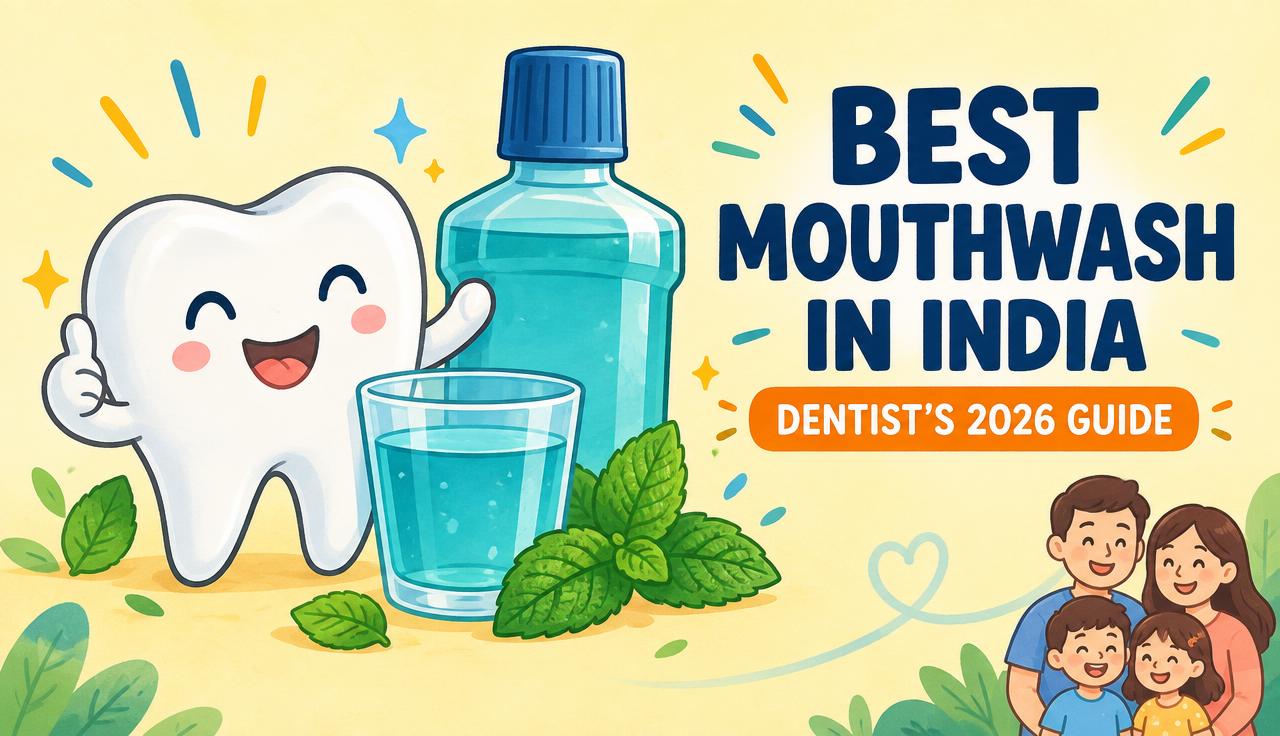
India's pharmacy shelves are packed with mint rinses promising fresh breath, fewer cavities and healthier gums. But the best mouthwash in India is not one brand for everyone. The useful choice depends on the problem you are trying to solve—and some medicated rinses should only be used for a short time.
Choose mouthwash by the problem—not the advertising
| Your goal | Look for | Important caution |
|---|---|---|
| Prevent cavities | Sodium fluoride, alcohol-free | Do not swallow; usually 6+ only |
| Bleeding gums / gingivitis | Dentist-prescribed chlorhexidine | Short course; may stain teeth |
| Bad breath | CPC or zinc plus tongue cleaning | Persistent odour needs diagnosis |
| Dry or sensitive mouth | Alcohol-free, mild flavour | Avoid harsh essential-oil rinses |
1. Fluoride mouthwash: best for extra cavity protection
A fluoride rinse helps strengthen enamel and can support people with braces, repeated cavities, dry mouth or hard-to-clean areas. Read the active-ingredient panel instead of relying on words such as “complete” or “total”. An alcohol-free formula is usually easier to tolerate. Use it at a different time from brushing so it does not rinse away the concentrated fluoride left by toothpaste.
2. Chlorhexidine mouthwash: useful medicine, not a daily freshener
Chlorhexidine mouthwash has very high India-wide search interest, but it is commonly misunderstood. Dentists prescribe it for active gum inflammation, after selected procedures or when normal cleaning is temporarily difficult. It may cause brown staining, taste changes and extra tartar when overused. It cannot remove hardened tartar, so people with persistent bleeding still need an examination and often professional scaling.
3. Mouthwash for bad breath
A rinse containing cetylpyridinium chloride (CPC) or zinc may reduce odour-producing bacteria. Yet fresh mint can mask rather than cure the problem. Clean the tongue daily, drink enough water and clean between teeth. If bad breath continues for more than two weeks, check for gum disease, decay, dry mouth, tonsil problems or another cause. See our detailed guide to bad breath in children.
Is Listerine, Colgate or a herbal mouthwash best?
Brand is less important than the active ingredient, age label and reason for use. Essential-oil rinses can reduce plaque but may feel strong. Fluoride rinses add cavity protection. Herbal rinses may freshen breath, but “natural” does not automatically mean clinically effective or safe to swallow. Compare labels, not bottle colours or celebrity claims.
Can children use mouthwash?
Most children under 6 should not use mouthwash because swallowing is common. From age 6, an alcohol-free fluoride rinse may be considered only when the child can reliably swish and spit and a dentist sees a benefit—for example, braces or high cavity risk. Adult chlorhexidine and strong essential-oil rinses should never be casually given to children.
How to use mouthwash correctly
- Measure only the label-directed amount; do not dilute unless instructed.
- Swish for the stated time, commonly 30–60 seconds.
- Spit completely. Never swallow.
- Do not rinse with water afterwards.
- Avoid food and drink for about 30 minutes.
- Use at a different time from toothbrushing unless your dentist says otherwise.
Mouthwash mistakes dentists see every week
- Using rinse instead of brushing twice daily with fluoride toothpaste
- Continuing chlorhexidine for months without review
- Giving an adult rinse to a young child
- Ignoring bleeding gums because a rinse temporarily reduces them
- Buying a “whitening” rinse for stains that actually need cleaning
- Using a burning product despite ulcers, dry mouth or irritation
When mouthwash is not enough
Book a dental check if you have bleeding lasting more than two weeks, tooth pain, swelling, loose teeth, repeated ulcers, a bad taste from one tooth or breath that does not improve. At Little Angels Kids Dental Care, Dr. Yash Lalwani treats adults as well as children and can identify whether the answer is cleaning, cavity care, gum treatment or a simple home-care change.
Our practical India buying checklist
- Check the active ingredient and its intended purpose.
- Prefer alcohol-free for children over 6, dry mouth and sensitivity.
- Check age restrictions and never assume “family” means toddler-safe.
- Look for an intact seal, expiry date and clear Indian label.
- Do not self-prescribe medicated rinses for long-term use.
Frequently asked questions
Which mouthwash is best in India?
For everyday cavity prevention, choose an alcohol-free fluoride mouthwash and check the label for sodium fluoride. For gum disease, chlorhexidine may be prescribed for a short course, but it is not an everyday long-term rinse.
Can I use chlorhexidine mouthwash every day?
Only when a dentist prescribes it and usually for a limited period. Long-term use may stain teeth, alter taste and increase tartar.
Is mouthwash safe for children?
Children under 6 should generally not use mouthwash because they may swallow it. Older children should use only an age-appropriate alcohol-free fluoride rinse under adult supervision and only if their dentist recommends it.
Does mouthwash cure bad breath?
It can temporarily reduce odour, but persistent bad breath may come from tongue coating, gum disease, cavities, dry mouth or another health issue. The cause needs treatment.
Should I rinse with water after mouthwash?
No. Spit the rinse out and avoid eating, drinking or rinsing with water for about 30 minutes so the active ingredient can work.
Can mouthwash replace brushing?
No. Mouthwash cannot remove sticky plaque. Brush twice daily with fluoride toothpaste and clean between teeth; use mouthwash only as an extra step.
Is alcohol-free mouthwash better?
It is usually gentler for children over 6, people with dry mouth, mouth ulcers or sensitivity. Alcohol is not required for fluoride protection.
When should I use mouthwash—before or after brushing?
Use it at a different time from brushing, such as after lunch. Using it straight after toothpaste can wash away concentrated fluoride.
Which mouthwash helps bleeding gums?
A dentist may advise chlorhexidine for active gingivitis alongside professional cleaning and daily plaque removal. Mouthwash alone cannot remove tartar.
What if mouthwash burns my mouth?
Stop using it, rinse with plain water and choose a milder alcohol-free product. Seek dental advice if burning, ulcers or swelling continue.
Related dental guides
- Bleeding gums: causes and treatment
- Best toothpaste for kids in India
- Mouth ulcers in kids
- Professional dental cleaning in Bharuch
Want advice for your family's smile?
Get a clear, personalised recommendation from Dr. Yash Lalwani at Little Angels Kids Dental Care in Bharuch.
Ask the dentist